
Picture this, you've a hotel booking portal. You've aggregated data from 15 lakh hotels and, to make your inventory as comprehensive as possible, you've plugged in 12 different suppliers. Impressive scale, right?
Then you actually look at the data. Addresses are wrong. Hero images on 4-star properties look like they belong to a highway motel. The same hotel shows up under six different names depending on which supplier you're looking at.
For example:
| Supplier | Hotel Code | Hotel Name | Address | Price |
|---|---|---|---|---|
| TBO | TBO_789 | Atlantis The Palm | Crescent Rd, The Palm Jumeirah, Dubai | $120 |
| Expedia | EXP_163 | The Palm Atlantis | Dubai, Crescent Road | $150 |
| Booking | BOOK_2356 | The Palm Dubai | The Palm Jumeirah, Dubai | $180 |
Suddenly, “comprehensive” doesn't feel like a win anymore.
The industry's first instinct: hire people to fix it
This is exactly where most OTAs and booking platforms have landed. Faced with messy, inconsistent data, they did what seemed logical — they hired teams specifically to clean the data. Manually. Entry by entry.
The cost of that choice? Slower time-to-market. Bloated operational budgets. And talented people spend their days doing work that shouldn't require human intelligence in the first place.
But here's the harder truth: even if you clean every single record perfectly, you haven't actually solved the problem.
This was never a data quality problem
Let's say you clean all 15 lakh hotel records across all 12 suppliers. You still end up with 12 separate entries for the same hotel, each with its own formatting quirks, naming conventions, and update cycles. And the inconsistencies run deeper than just addresses and images.
Take Atlantis The Palm in Dubai as a real example. TBO lists it as “Atlantis The Palm” at Crescent Rd, The Palm Jumeirah, Dubai for $120. Expedia calls it “The Palm Atlantis” at Dubai, Crescent Road for $150. Booking.com has it as “The Palm Dubai” at The Palm Jumeirah, Dubai for $180.
Three suppliers, three different names, three different addresses, three different prices, and they're all talking about the exact same hotel.
This is the price problem hiding in plain sight. A traveller searching for “Atlantis The Palm” might not even find it if your platform is pulling from a supplier that listed it differently. And even if they do find it, seeing wildly different prices for what appears to be different hotels doesn't inspire confidence, it creates confusion and kills the booking.
The moment any supplier pushes a new update, the “clean” version you worked so hard to maintain starts drifting again.
The real issue isn't dirty data. It's the absence of a single source of truth.
The shift that actually works: a Standardized Hotel Data Repository
The sustainable fix requires rethinking the architecture entirely. Instead of patching data after the fact, the answer lies in building a Standardized Hotel Data Repository, a centralised, deduplicated, continuously maintained database where every property has one identity.
The way this works in practice is through unique hotel codes, identifiers assigned not by any individual supplier, but by a neutral technology layer. Each hotel gets one canonical code, one verified name, one accurate address regardless of how many suppliers are feeding data into your system.
This means no duplicates, no conflicting records, and no manual reconciliation every time a supplier updates their feed.
{
  "standardized_hotel_id": "1577837",
  "standardized_hotel_name": "Setrac Grange",
  "standardized_address": "501 Neco Chambers Plot 48, Sector 11 CBD Belapur, Navi Mumbai 400614",
  "standardized_city": "Navi Mumbai",
  "latitude": "19.015024",
  "longitude": "73.04127",
  "standardized_city_code": "STR-IN-0648",
  "standardized_country_code": "SI-IN",
  "provider_details": [
    {
      "supplier_name": "amadeus",
      "supplier_id": "GCBOM0PZ",
      "hotel_name": "SETRAC GRANGE",
      "address": "501 NECO CHAMBERS PLOT 48, SECTOR 11 CBD BELAPUR, MUMBAI, 400614",
      "supplier_city": "Mumbai"
    },
    {
      "supplier_name": "grn",
      "supplier_id": "1418522",
      "hotel_name": "Setrac Grange",
      "address": "501 Neco Chambers Plot 48, Sector 11 CBD Belapur, Navi Mumbai 400614",
      "supplier_city": "Mumbai"
    }
  ]
}
Fig. A Glimpse into the Capability of Standardized Hotel Data Repository.
A critical detail most people overlook
A Standardized Hotel Data Repository isn't something you build once and walk away from. Hotel data is living data, properties open, rebrand, renovate, and change ownership faster than any static database can keep up with. To be genuinely useful, the repository needs continuous updates baked into the process, not treated as an afterthought.
What Structurrai does differently
At Structurrai, we don't just map the correct data, we keep it current and relevant for you.
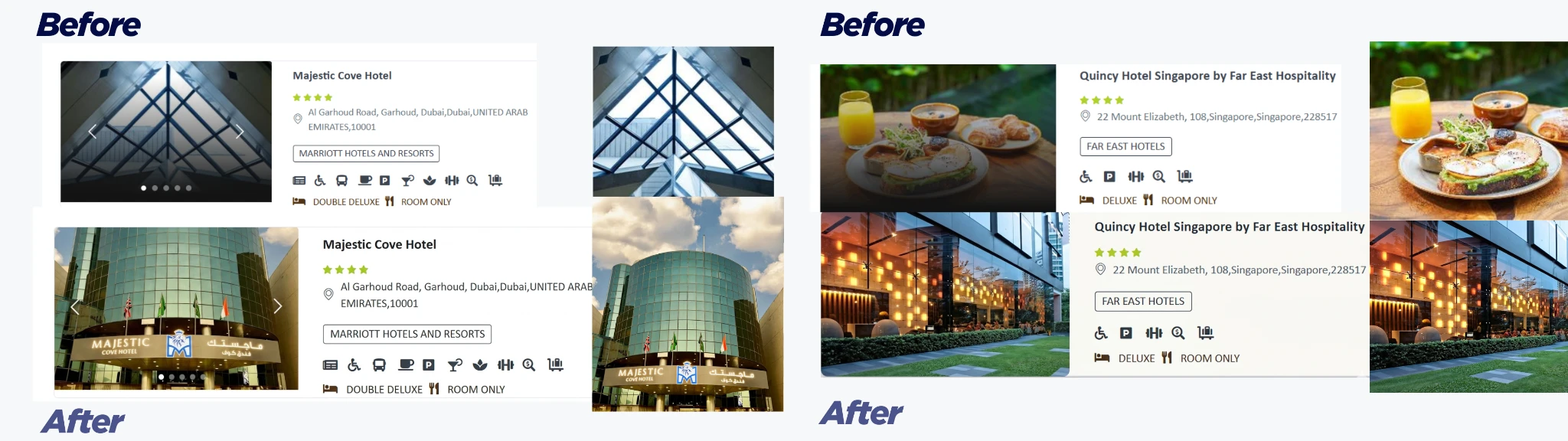
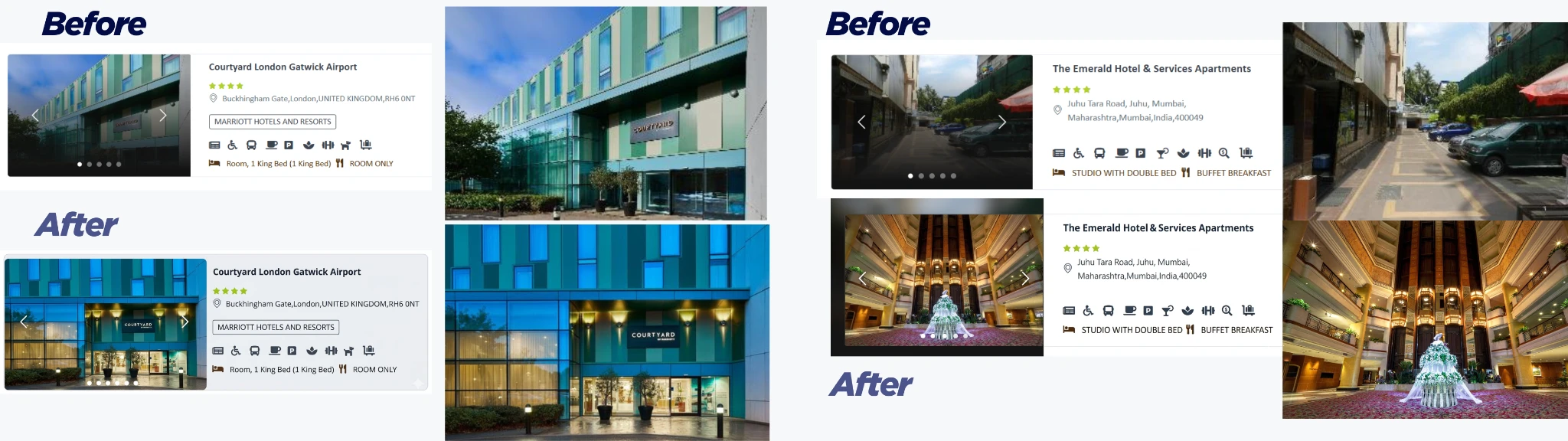
Take hero images as an example. When a traveller searches for a hotel, the hero image is often the first thing that shapes their decision. A misrepresentative image, an outdated lobby shot, a photo from a completely different property, doesn't just look bad. It breaks trust at the exact moment you're trying to earn it.
We identify these mismatches and correct them. The images below show four properties across different global destinations, all 4-star rated, and the difference between a wrong hero image and the right one is stark. It's not a minor UX fix. It's the difference between a booking and a bounce.
Building a great hotel portal isn't just about how many properties you list. It's about how accurately and consistently you represent each one. That starts with getting the foundation right.
Build Your Standardized Hotel Data Repository
Discover how to eliminate duplicates, ensure data accuracy, and deliver a trustworthy booking experience for your customers.
Schedule a Demo TodayStop patching messy data, build a single source of truth.

Vasu Goenka is an accomplished engineering and business professional with over a decade of experience in the travel and consumer tech industries. A graduate of one of India's premier institutes, he co-founded StructurrAI with a vision to harness the power of Generative AI and AI Agents to transform the travel industry.
Managing hotel data from multiple suppliers is one of the biggest challenges in the travel tech industry, duplicates, mismatched room categories, and inconsistent details create inefficiencies. StructurrAI leverages Generative AI and AI Agents to solve these problems, providing travel companies with:
🏨 Hotel Mapping
Eliminates duplicates and consolidates listings across all suppliers.
🛏️ Room Mapping
Organizes and standardizes room categories for seamless comparison.
📋 Website grade Content
Ensures hotel data remains accurate, structured, and consistent.
With StructurrAI, travel businesses can streamline operations, enhance data reliability, and deliver a superior booking experience.